
Electrical resistivity measures how strongly a material opposes electric current. For a uniform conductor, the resistivity formula is ρ = RA/L. The SI unit is the ohm-metre (Ω·m).
Electrical resistivity formula and units
| ρ | Electrical resistivity, Ω·m |
| R | Electrical resistance, Ω |
| A | Cross-sectional area, m2 |
| L | Length, m |
Worked example: calculating resistivity
Suppose a 100 m length of uniform copper conductor has a cross-sectional area of 16 mm² and a measured DC resistance of 0.108 Ω at 20 °C. First, convert the area to square metres: 16 mm² = 16 × 10−6 m².
Substitute the values into the formula: ρ = (0.108 Ω × 16 × 10−6 m²) / 100 m ≈ 1.73 × 10⁻⁸ Ω·m.
Resistivity and conductivity
Electrical resistivity is the reciprocal of conductivity: ρ = 1/σ, where σ is conductivity in siemens per metre (S/m).
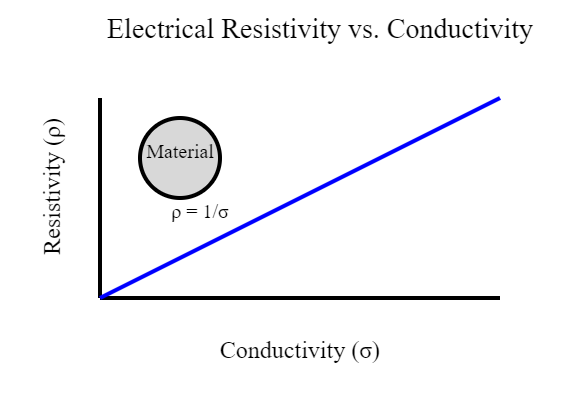
Materials with high resistivity have low conductivity. Materials with low resistivity, such as copper and aluminium, conduct current efficiently and are therefore commonly used for cable conductors.
Factors affecting resistivity
- Temperature: in most conductor materials, resistivity increases with temperature.
- Composition: metals with more free electrons usually have lower resistivity than ceramics, polymers or other insulating materials.
- Microstructure: crystalline structure, impurities, and processing can influence electron movement and, therefore, resistivity.
Applications of electrical resistivity
- Electrical wiring: low-resistivity materials such as copper and aluminium reduce conductor losses.
- Heating elements: higher-resistivity materials such as nichrome and tungsten can generate heat.
- Sensors: materials whose resistivity varies with temperature, pressure or strain are used in devices such as thermistors and strain gauges.
- Resistors: electronic resistors use controlled resistance values to limit or divide current and voltage.
Use in cable calculations
To estimate a conductor’s DC resistance from its resistivity, rearrange the formula to R = ρL/A. Use the length of one conductor to calculate its one-way resistance. In cable calculations, conductor resistance affects voltage drop, power loss, impedance and fault current.
For conductor resistance calculations, resistivity is normally referenced to 20 °C and then adjusted to the expected operating temperature. For cable sizing, this affects both voltage drop and heat generation.
For related calculations, see Conductor Resistance, Cable Impedance and Cable Power Loss.