
Electrical resistance measures how strongly a conductor or material opposes the flow of electric current. It is denoted by R and measured in ohms.
In cable engineering, resistance is a key input to conductor heating, voltage drop, power loss, impedance and fault-current calculations. For cable-specific resistance methods, see Conductor Resistance.
Factors affecting electrical resistance
- Material: different materials have different electrical resistivities. Copper and aluminium have low resistivity; insulating materials have high resistivity.
- Length: a longer conductor has higher resistance.
- Cross-sectional area: a larger conductor area gives lower resistance.
- Temperature: for most conductor materials, resistance increases as temperature increases.
Calculating electrical resistance
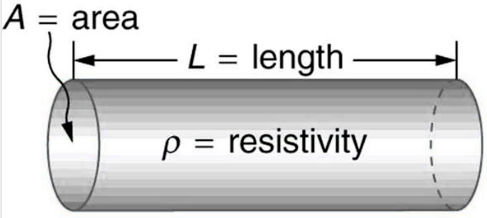
The resistance of a conductor can be calculated from resistivity, length and area:
| R | Electrical resistance, ohm |
| ρ | Electrical resistivity of the material, ohm.m |
| L | Length of conductor, m |
| A | Cross-sectional area, m2 |
This shows that resistance is directly proportional to length and resistivity, and inversely proportional to cross-sectional area. A longer or higher-resistivity conductor has more resistance; a larger conductor has less resistance.
Example
A copper wire has a length of 10 m and a cross-sectional area of 0.5 mm2. Taking copper resistivity as 1.68 x 10⁻⁸ ohm.m:
The calculated resistance is approximately 0.336 ohm.
Temperature effects on resistance
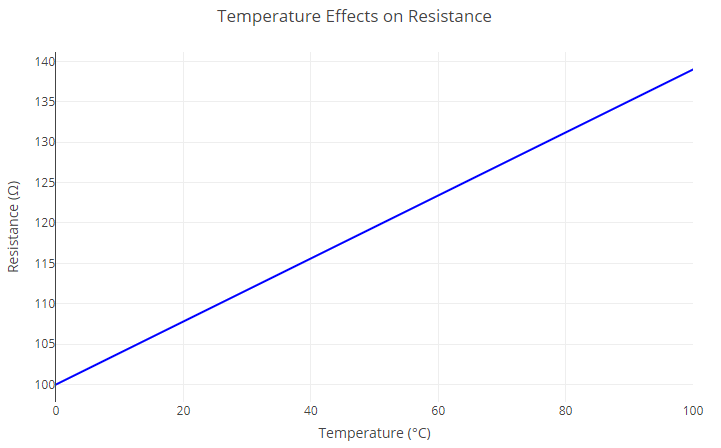
The resistance of most conductor materials increases as temperature increases. The temperature coefficient of resistance describes how much resistance changes with temperature:
| α | Temperature coefficient of resistance, per degree Celsius |
| R | Electrical resistance at the reference condition |
| dR/dT | Rate of change of resistance with temperature |
For a linear approximation over the temperature range of interest, resistance at a new temperature can be estimated from:
| R | Resistance at the given temperature |
| R0 | Resistance at the reference temperature |
| α20 | Temperature coefficient at 20 °C |
| T1 | Reference temperature, °C |
| T2 | Given temperature, °C |
Most metallic conductors have a positive temperature coefficient. Some materials, such as carbon and silicon, may have a negative temperature coefficient over relevant operating ranges.
Use in cable calculations
Resistance is the real part of cable impedance. It directly affects Cable Power Loss, Voltage Drop and Cable Impedance. The material property behind resistance is Electrical Resistivity.