
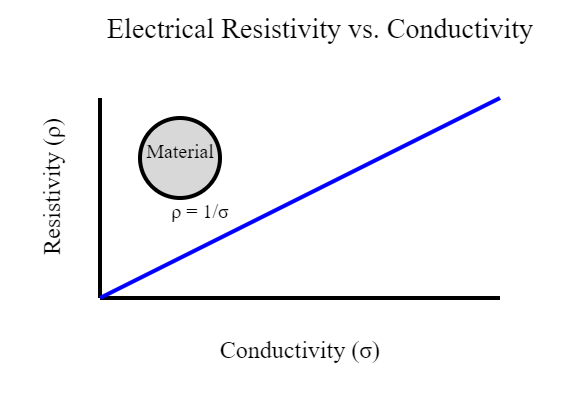
Electrical resistivity, sometimes called specific electrical resistance, is a material property that describes how strongly a material opposes the flow of electric current. It is the inverse of electrical conductivity.
In cable calculations, resistivity is used to estimate conductor resistance, which then affects voltage drop, power loss, impedance and fault-current calculations.
Definition of electrical resistivity
Electrical resistivity is defined as resistance normalised by conductor length and cross-sectional area. It is denoted by ρ and is measured in ohm-metres:
| ρ | Electrical resistivity, ohm.m |
| R | Electrical resistance, ohm |
| A | Cross-sectional area, m2 |
| L | Length, m |
Materials with high resistivity have low conductivity. Materials with low resistivity, such as copper and aluminium, conduct current efficiently and are therefore commonly used for cable conductors.
Factors affecting resistivity
- Temperature: in most conductor materials, resistivity increases as temperature increases.
- Composition: metals with more free electrons usually have lower resistivity than ceramics, polymers or other insulating materials.
- Microstructure: crystalline structure, impurities and material processing can influence electron movement and therefore resistivity.
Applications of electrical resistivity
- Electrical wiring: low-resistivity materials such as copper and aluminium reduce conductor losses.
- Heating elements: higher-resistivity materials such as nichrome and tungsten can be used to generate heat.
- Sensors: materials whose resistivity varies with temperature, pressure or strain are used in devices such as thermistors and strain gauges.
- Resistors: electronic resistors use controlled resistance values to limit or divide current and voltage.
Use in cable calculations
For conductor resistance calculations, resistivity is normally referenced to 20 °C and then adjusted to the expected operating temperature. For cable sizing, this affects both voltage drop and heat generation.
For related calculations, see Conductor Resistance, Cable Impedance and Cable Power Loss.