
BS 7671:2018+A4:2026 Appendix 4 gives a practical method for calculating voltage drop in low voltage cables. The method uses tabulated resistive and reactive voltage drop values, expressed in mV/A/m, and applies them to the design current, route length and load power factor.
This note sits alongside the broader Voltage Drop Calculations for Cable Sizing article. For the wider standards context, see Cable Sizing Standards: BS 7671, ERA 69-30 and IEC 60502.
Recommended maximum voltage drop
BS 7671 Appendix 4 gives recommended maximum voltage-drop values according to the type of final circuit and the supply arrangement. These values are informative; the requirements of the connected equipment and the total voltage drop between the origin of the installation and the load point should also be considered.
| Supply arrangement | Lighting | Other uses |
|---|---|---|
| Low voltage installation supplied directly from a public LV distribution system | 3% | 5% |
| Low voltage installation supplied from a private LV supply | 6% | 8% |
BS 7671 voltage drop calculation
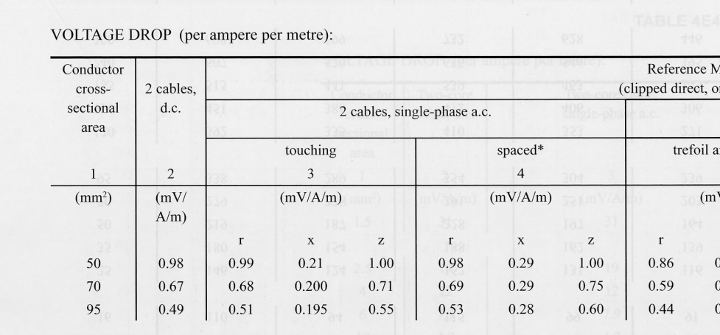
The BS 7671 tables give voltage drop values for different cable types and installation arrangements. The values are related to the cable maximum operating temperature and the line-to-neutral or line-to-line voltage, depending on whether the circuit is single-phase or three-phase.
Where the conductor is expected to operate below its maximum temperature, BS 7671 includes a temperature correction factor:
The voltage drop can then be calculated using the tabulated components associated with conductor resistance and cable reactance:
In this expression, Ib is the design current, L is the cable length, Ct is the temperature correction factor and φ is the load power factor angle.
Using table values as impedance
The mV/A/m values can also be converted to resistance and reactance for use in cable impedance calculations.
DC circuits
Single-phase AC circuits
Three-phase AC circuits
For three-phase circuits the BS 7671 mV/A/m values are divided by √3 when converting them to the per-line impedance values used by CENELEC TR 50480 style calculations.
Power factor
The cosine term in the voltage drop equation is the load power factor:
Where load power factor is not known, the selected design assumption should be stated because it affects the balance between the resistive and reactive voltage drop components.
BS 7671 voltage drop worked example
The following worked example shows how to apply the BS 7671 method when the tabulated resistive and reactive voltage drop values are known. It uses a 50 mm2 single-core armoured copper cable carrying 152 A over an 80 m route.
Problem
Check the voltage drop for a three-phase circuit and express the result both in volts and as a percentage of the 400 V line-to-line system voltage.
Given data
| Item | Value |
|---|---|
| Cable type | Table 4E3A, single-core armoured 90 °C thermosetting copper conductors |
| Conductor size | 50 mm2 |
| Route length, L | 80 m |
| Design current, Ib | 152 A |
| System voltage, U | 400 V line-to-line |
| Power factor, cos φ | 0.87 |
| Maximum conductor temperature, tp | 90 °C |
BS 7671 lookup values
| Value | Description |
|---|---|
| It = 222 A | Tabulated current rating |
| mVr = 0.86 mV/A/m | Resistive component of voltage drop |
| mVx = 0.29 mV/A/m | Reactive component of voltage drop |
| Ca = 0.96 | Ambient temperature correction factor |
| Cg = 1.00 | Grouping correction factor |
| Cs = 1.00 | Soil thermal resistivity correction factor, not buried |
| Cd = 1.00 | Burial depth correction factor, not buried |
Step 1: resolve the power factor components
The resistive component uses cos φ directly. The reactive component uses sin φ, calculated from the power factor.
Step 2: calculate the temperature correction factor
The correction factor accounts for the cable operating below its maximum permitted conductor temperature.
Step 3: calculate voltage drop
The BS 7671 voltage drop calculation combines the corrected resistive component and the reactive component.
Step 4: convert to percentage voltage drop
Result: the calculated voltage drop is 10.06 V, or 2.52% of the 400 V line-to-line voltage. For project work, our cable sizing software brings voltage-drop, current-capacity and fault checks together with the supporting cable records and reports.