
Cable impedance is central to voltage drop, power loss, short-circuit current and earth-fault calculations. In many cases cable impedance can be calculated using IEC 60909-2, Short-circuit currents in three-phase a.c. systems – Part 2: Data of electrical equipment for short-circuit current calculations.
IEC 60909-2 gives formulae for single-core and multicore cables, with or without metallic sheaths or shields. Where a particular arrangement is not covered directly, the fundamental inductance and reactance relationships can be used to derive a suitable approximation. For project work, our cable sizing software brings impedance-based voltage-drop and fault calculations together with cable records and engineering reports.
Fundamental equations
For a single conductor, the internal self-inductance due to its own magnetic field is:
The corresponding reactance is:
| μ0 | Permeability of free space, 4π x 10-7 N/A2 |
| L | Self-inductance, H/m |
| X | Reactance, ohm/m |
| ω | Angular frequency, 2πf |
For a second external conductor, the inductance due to the field from the other conductor is:
For two parallel conductors, the total inductance and reactance of one conductor are:
Where conductor spacing varies, geometric mean spacing can be used. For three single-core cables in flat formation:
For more background, see Geometric Mean Distance.
Zero sequence impedance
The fundamental equations above are suitable for positive sequence impedance. Zero sequence impedance is more difficult because the return path can include neutral conductors, cable sheaths, armour, screens, earth and nearby metallic structures. IEC 60909 formulae are normally used directly for practical calculations.
For some zero sequence calculations it is necessary to consider equivalent soil penetration depth:
| δ | Equivalent soil penetration depth, m |
| ρ | Soil resistivity, ohm.m |
| μ0 | Permeability of free space, H/m |
Cables without metallic sheaths or shields
Single-core cables
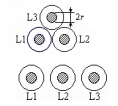
Positive sequence impedance, phase or neutral:
Zero sequence impedance, current return through earth:
Zero sequence impedance, current return through fourth conductor:
Zero sequence impedance, current return through fourth conductor and earth:
Multicore cables
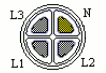
For a three-core or four-core cable without metallic sheath or shield, the positive sequence impedance uses the same form as the single-core positive sequence equation above.
Zero sequence impedance, current return through full-size fourth conductor:
Zero sequence impedance, current return through reduced-size fourth conductor:
Zero sequence impedance, current return through full-size fourth conductor and earth:
Zero sequence impedance, current return through reduced-size fourth conductor and earth:
Cables with metallic sheaths or shields
Single-core cables
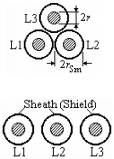
Positive sequence impedance for cables bonded at both ends:
IEC 60909 does not give a direct equation for zero sequence impedance with current return through shield only in this case.
Zero sequence impedance, current return through shield and earth:
Multicore cables
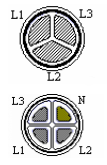
For a three-core or four-core cable with metallic sheath or shield, the positive sequence impedance uses the same positive sequence form as equation 10.
Zero sequence impedance, current return through screen:
Zero sequence impedance, current return through screen and earth:
Zero sequence impedance, current return through fourth conductor and screen:
Zero sequence impedance, current return through fourth conductor, screen and earth:
With:
Zero sequence impedance is strongly affected by cable construction, bonding, sheaths, armour, soil, pipes, nearby steelwork and other return paths. Dependable zero sequence values are often best obtained by measurement on the installed cable system.
Symbols
| d | Geometric mean spacing, line-to-line, m |
| dLN | Geometric mean spacing, line-to-neutral, m |
| RL | Conductor resistance, ohm or ohm/m |
| RN | Neutral or fourth conductor resistance, ohm or ohm/m |
| RS | Metallic sheath or screen resistance, ohm or ohm/m |
| μ0 | Permeability of free space, 4π x 10-7 H/m |
| rL | Radius of the conductor, m |
| rN | Radius of the neutral or fourth conductor, m |
| rSm | Mean radius of sheath or shield, 0.5(rSi + rSa), m |
| δ | Equivalent soil penetration depth, m |
Related topics
- Conductor resistance
- Inductance
- Electrical resistivity
- Reactance
- Resistance
- Example impedance flow
For applications of impedance in cable calculations, see Voltage Drop, IEC 60909 Fault Calculations and Earth Fault Loop Impedance.