
Cable thermal withstand can be checked by comparing the maximum energy let-through during a fault with the maximum energy the cable conductor can absorb without exceeding its permissible temperature.
Energy-limiting protective devices reduce the I2t let-through during a fault. This can be important when checking whether a cable can thermally withstand a prospective short-circuit condition.
I2t withstand condition
The basic condition is:
| I2t | Energy let-through of the protective device during the fault |
| I | Fault current, A |
| t | Fault duration, s |
| k2A2 | Energy withstand of the cable conductor |
| k | Adiabatic constant |
| A | Cable cross-sectional area, mm2 |
If the device let-through energy is less than or equal to the cable withstand energy, the cable is thermally protected for the assessed fault condition.
Energy-limiting protective devices
The let-through energy is normally specified by the protective device manufacturer. For thermal-withstand checks, the manufacturer’s published I2t value should be compared with the cable’s allowable withstand value.
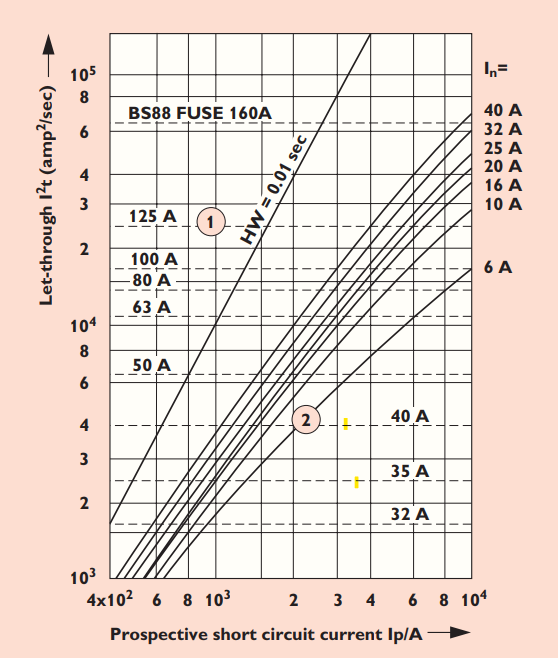
Using the typical data above, a 10 A, 10 kA fault-rated MCB has an Ip/A value of approximately 1000, or 103. This gives an energy let-through of approximately 2,000 A2s.
Actual values depend on the protective device type, rating, fault level and manufacturer data. Always use the published let-through values for the selected device when completing a design calculation.