
From 1 July 2017, cables placed on the European Union market for use in construction works have needed to comply with the Construction Products Regulation (CPR), Regulation (EU) No. 305/2011. For relevant cables, this means specifying CPR CE-marked products with a declared reaction-to-fire performance.
Requirements can vary by country and project type, so always check the applicable national regulations, authority guidance and project specification before selecting a CPR class. More information for the UK can be found on the Government’s Construction Products Regulation in Great Britain page.
How CPR cable classification works
CPR creates a harmonised approach for describing the fire performance of cables. The main reaction-to-fire class runs from Aca to Fca, with Aca representing the highest performance and Fca the lowest. Additional classifications describe smoke production, flaming droplets and acidity.
| Class | Typical performance description |
|---|---|
| Aca | High-performance products which practically cannot burn; PCS test basis. |
| B1ca | No, or very little, burning under a 30 kW flame source; assessed using FIGRA, FS, H, HRR and THR. |
| B2ca | Very little burning under a 20.5 kW flame source; assessed using FS, THR, HRR and FIGRA. |
| Cca | Continuous flame spread with limited fire growth and limited heat release under a 20.5 kW flame source. |
| Dca | Continuous flame spread with moderate fire growth and moderate heat release under a 20.5 kW flame source. |
| Eca | Products subject to a small flame attack which do not cause a large flame spread. |
| Fca | Products with no performance determined, or products which do not meet class Eca. |
Abbreviations used in CPR cable tests
| FIGRA | Fire growth rate index, test method EN 50399. |
| FS | Vertical flame spread, test method EN 50399. |
| H | Vertical flame spread, test method EN 60332-1-2. |
| HRR | Maximum value of heat release, test method EN 50399. |
| PCS | Gross heat of combustion, test method EN ISO 1716. |
| THR | Total heat release, test method EN 50399. |
Classes B1ca to Dca include additional tests for smoke production, flaming droplets and acidity.
Reaction-to-fire properties
For cables, CPR reaction-to-fire performance is considered with reference to EN 50575, Power, control and communication cables. Cables for general applications in construction works subject to reaction to fire requirements. The fire testing considers five properties:
- Flame spread
- Heat release
- Smoke production, from s1 (best visibility) to s3 (low visibility)
- Flaming droplets, from d0 (no droplets) to d2 (long or persistent droplets)
- Acidity, from a1 (low acid cables) to a3 (standard cables)
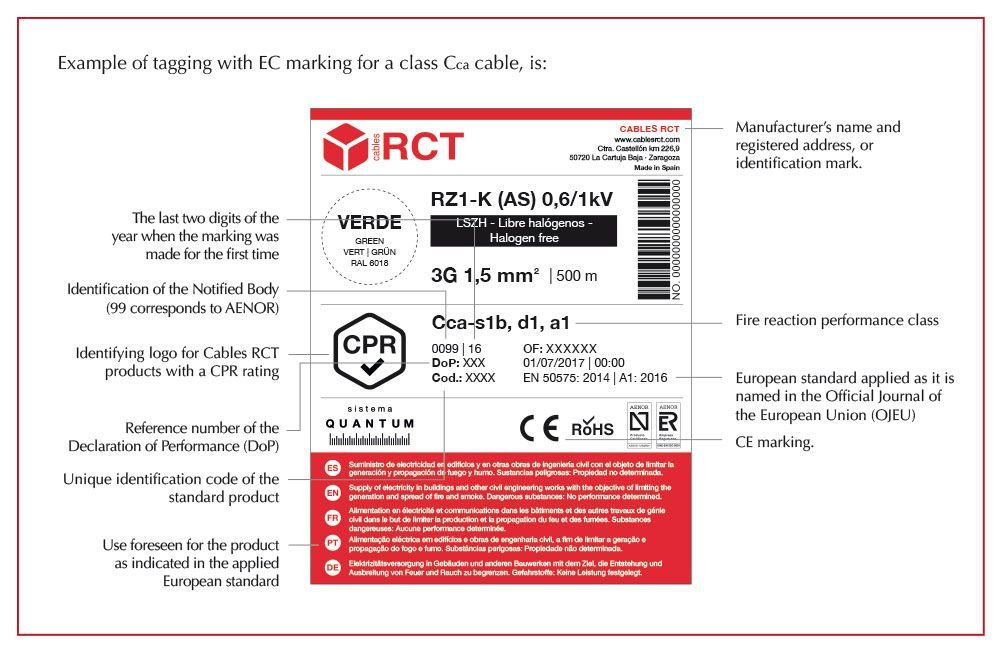
The full classification combines the main class and the additional properties. For example: Cca-s1b,d1,a1.
CPR applies to power, control, communication and optical fibre cables, at all voltages, where they are installed as part of fixed installations in construction works. Some special applications may be exempt under national rules, and national authorities may specify particular CPR classifications for different installation types.
Labelling and declarations of performance
Manufacturers are required to provide mandatory labelling information and a Declaration of Performance (DoP) for relevant CPR-classified products.
Specifying CPR-rated cables
When specifying cables, check the relevant national regulating authority and project requirements for the required CPR class and additional classifications.
In the absence of specific guidance, common industry practice is to specify class Eca or higher, using Low Smoke Zero Halogen (LSZH) insulated and sheathed cables. For fire-sensitive installations, higher classes should be considered.